The Head’s Address at the Bradfield College Remembrance Sunday Service, Sunday 8th November 2026
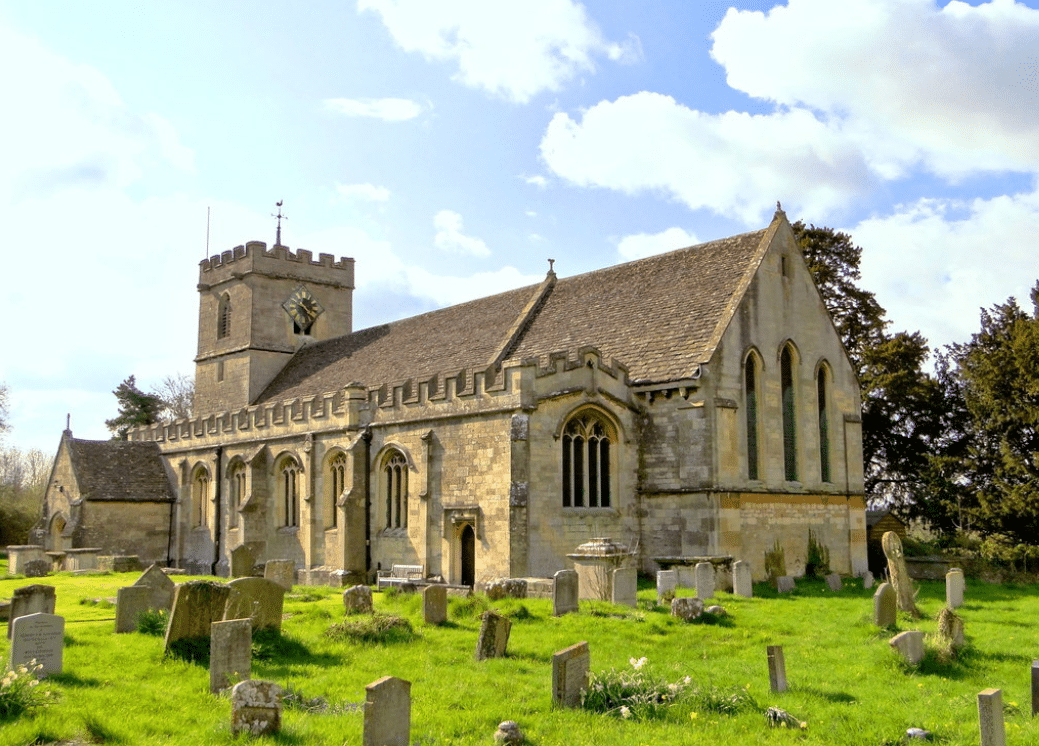
The Gloucestershire village of King’s Stanley is mentioned in the Domesday Book of 1086. There is little of note in the village apart from the 12th century parish church of St George and the impressive cast iron and brick edifice that housed the once thriving Stanley woollen mill. Nestled between Stonehouse and the dramatic slopes of Selsey Common, the picturesque stone cottages so typical of the Cotswolds, lends the village a timeless and slightly somnolent feel. This is the bucolic West Country portrayed by Edward Elgar, Ivor Gurney and Laurie Lee. Orchards filled with rosy apples, country lanes winding their way through fields of golden corn. Old Gloucester cows lazily grazing in verdant pastures. Aside from the impressive steam engines that powered the looms in the woollen mill, the march of modernity had yet to embrace this sleepy corner of rural England in at the turn of the twentieth century.
It was in this rather gentle world that Richard William Jennings was born on 6th March 1889. His father Arthur was the local parish priest and a dazzlingly brilliant academic who wrote extensively on ecclesiastical history. His mother, Georgiana, was the daughter of Colonel Robert Wale of Little Shelford in Cambridgeshire. Robert was Honorary Colonel of the Cambridgeshire Militia, Deputy Lieutenant for Cambridgeshire and an esteemed local magistrate. Consequently, Richard’s family could reasonably be described as being firmly ‘establishment‘ and part of the military, legal and religious fabric of late Victorian life. It was a family dedicated to public service.
Three years earlier, a baby boy called Thomas had been born in Birmingham in rather different circumstances. His father, William, was a bricklayer from Coventry, and his mother, Ellen, came from Dudley in Staffordshire. Sadly, Ellen died in 1895 when Thomas was just eight years old. His father remarried and so Thomas acquired numerous step siblings. In the 1901 census, there were eleven people living in the family home. Thomas left school early and became a painter and decorator. Immediately before the outbreak of the First World War, Tom was married and employed by the local Council. Tom joined the 10th Battalion of the Worcestershire Regiment in December 1914 and he was posted to France in the summer of 1915. Soon after arriving, he learned that his wife Mary had become very seriously ill. Tom was granted permission to return to England to visit her but returned to France upon the conclusion of this period of leave. In December she died, leaving behind a one-year-old daughter called Lillian – Tom’s only child.
Tom was denied permission to return for the funeral, and the future care of his daughter was entrusted to family members. The situation must have been utterly heartbreaking, and it is perhaps not surprising that Tom acquired a reputation for being a ‘difficult’ soldier and something of a reprobate. In early 1916, the battalion took part in a counteroffensive against a German position north of the Somme, in order to help relieve pressure on the French at Verdun. We know that Tom did not take part in this attack as he was being held in military custody on disciplinary charges.
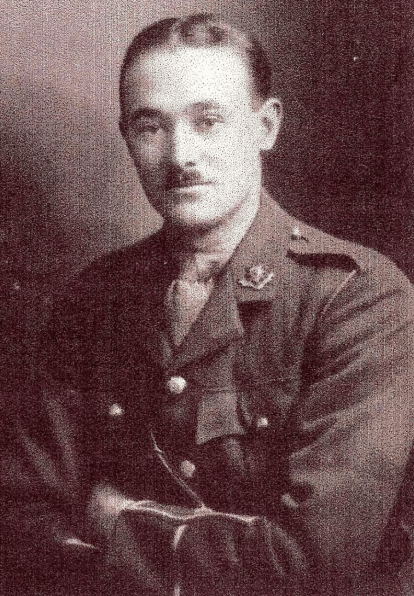
Let us return to the story of Richard Jennings. His start in life was much more promising. He was sent to Bradfield College alongside his older brother, Arthur. Academically gifted, Richard thrived at Bradfield. His notable sporting prowess was particularly apparent in the realm of boxing where he demonstrated a formidable talent. He won a place to study law at Jesus College, Cambridge, where he became an active member of the newly formed university boxing and fencing club. He was described as a splendid lightweight boxer, and the Jesus College Society Annual Report observes that he was a ‘very cool and clever motor cyclist’. Richard left Cambridge and moved to London to pursue a career as a solicitor. However, just four years later, the First World War broke out and like so many young men of his generation, Richard immediately enlisted. He joined the Worcestershire Regiment and quickly gained a reputation for outstanding bravery, and a fellow solider was later to observe that he was ‘an A1 officer, as brave as a lion, and loved and respected by us all’.
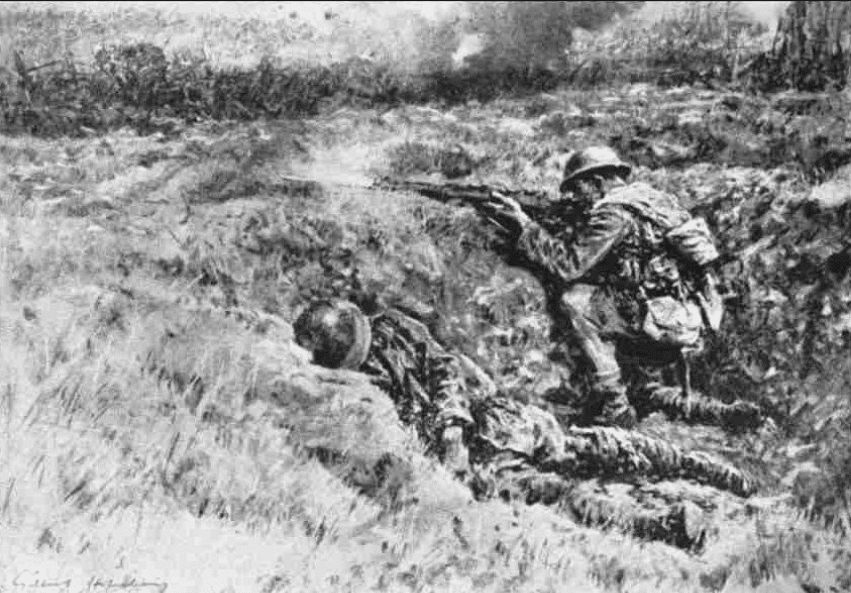
This is where the stories of Tom Turrall and Richard Jennings collide for it was Richard who requested Tom’s release from custody and return to active service within the 10th Battalion, and this is perhaps relevant to subsequent events. You will doubtless be familiar with the events of the single worst day in British history – the 1st of July 1916. It was on this day that the British launched a disastrous offensive against the Germans on the Somme. On that fateful day, the British sustained over 57,000 casualties with 19,240 deaths. Less than 48 hours later, at 3 am in the morning of 3rd of July, the 10th Battalion of the Worcestershire Regiment were sent ‘over the top’. To begin with, they made good progress and by midday they captured three lines of enemy trenches. However, as they tried to push through into a village, they encountered fierce resistance from a machine gun. Richard Jennings sustained a serious leg injury, and it was at this point that Tom Turrall dragged him into a shell hole for cover. The attentive Turrall tried to bandage his senior officer’s leg using his entrenching tool as a splint. They survived a German counterattack by pretending to be dead. Richard was hit twice more whilst they were lying in the shell hole. Tom kept him supplied with lit cigarettes which he could still hold with his functioning arm.
It was only as evening fell that Tom, under the cover of darkness, was able to drag Richard back to the relative safety of their own trenches. Richard was then taken by an ambulance to a field hospital but died soon after at the age of twenty-seven. He lived just long enough to learn that La Boisselle had been retaken by the Germans, and to relay the story of Tom’s exceptional courage under fire. Upon Richard’s recommendation, Tom was awarded the Victoria Cross, the highest award in the British Army granted to those who show conspicuous courage or exceptional valour in the presence of the enemy.
Following Richard’s death, there was an exchange of letters between Tom and Richard’s mother. They are as follows:
Dear Mrs Jennings,
I hope you will not think me taking a liberty writing to you in this manner, but I feel it is my duty to do so, as I was with him the whole time and I think you would like to hear the part we played. I must, first of all, congratulate you in possessing such a plucky son, for he led our company with such unflinching pluck that we were not long in taking the enemy’s front line.
I might say that when we reached it, we came across a dugout held by the Germans. Here your son remarked: ‘Give me a bomb and I will clear them out’. He did so. From there, we went on to the second line. This proved to be an easy thing for we did not find anyone there, so that made us more enterprising. We were not long before were in the third line. This is, I am sorry to say, the starting of our hard times, for it was here he received his first wound; a rifle shot in the muscle of the left arm.
Nothing daunted him. He kept on until he received another wound, a bomb this time which caught him in the right thig. I might say that it was from this time that we found ourselves practically cut off from the remainder of the battalion. It was here that a brother officer advised your son to seek medical aid, but he very pluckily refused, although had he chosen to act as advised, I am afraid he could not have done so as we two were not completely cut off. It was advisable to get what cover we could. So, we retired to a shell hole some distance in the rear. In doing so, your son, I am sorry to say, received two more wounds, one in the right knee and the other shattered his left leg a little below the knee. As we could get no further, I did all I could for him, using my entrenching tool handle and bayonet scabbard as splints. It is hard to tell you that we were obliged to remain like this for something like three and a half to four hours before I at last carried him in.
How he bore his pain was surprising, for he continually chatted and smoked with me until I at last managed to get him to the dressing station. It was here that we parted, but not without him thanking me for the part I played. I am sure in the success of the Worcesters in this battle that your son played a very prominent part although badly handicapped by his wounds. Hoping that this little but thrilling account will afford you some small consolation in your great loss and at the same time sending mine and my comrades’ sympathy.
Richard’s mother wrote to Tom’s stepmother and said:
”Will you let me know when your brave son is in England? I will go anywhere in England to see him and give him some special thing in memory of Lieutenant Jennings. Your son must be a hero and so strong, for my son was over six feet tall”.
Alongside this letter, Mrs Jennings included a booklet that she had printed in memory of her son. As for Thomas Turrall, he mentioned meeting King George V in France in 1917, but with characteristic modesty, he told his own parents nothing about his act of heroism. At the end of the war, he was released from service and remarried soon after. He returned to his job as a painter and decorator but continued to attend regimental events until his death in the mid-1960s. His life was beset by tragedy, and his only child died in 1942 at the age of 28. He sold his medals to supplement his meagre pension.
Ordinarily, it is highly unlikely that Thomas and Richard would have met one another. The life of Thomas was both ordinary and extraordinary. He was transfigured and immortalized by a single act of bravery. His story serves as a compelling example of how conflict serves as an intensifying agent capable of inspiring moments of unspeakable cruelty and acts of unfathomable courage. The story we have just explored connects us, through our association with this community, to the events on the Somme some hundred and ten years ago. It is our enduring responsibility to tell these stories and to reflect on the lessons to be learned from the sacrifice of those who have gone before.