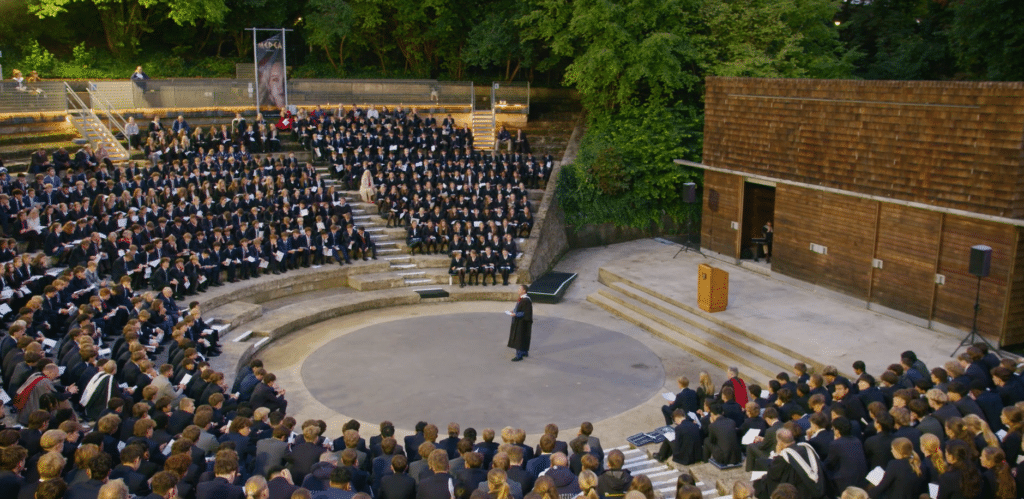
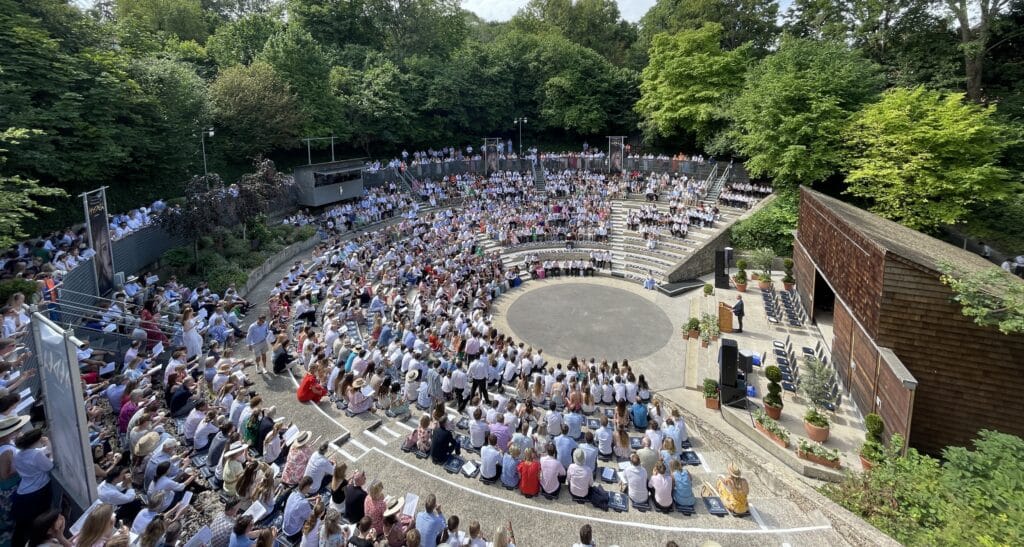
In yesterday evening’s Admission of Scholars Service, Head, Jeremy Quartermain, delivered an engaging and thought-provoking address on the value of intellectual curiosity and developing a lifelong love of learning through engaging with topics beyond your knowledge base.
Drawing on the purchase of a book about cattle from a secondhand bookshop in Sizergh Castle, Jeremy reflects on how even the most seemingly ordinary subjects can open doors to fascinating new areas of knowledge. What began as a chance encounter with a book about cows led him to exploring topics as diverse as farming, animal behaviour, genetics, environmental sustainability, history and culture.
Using this personal story, he encourages scholars to remain open-minded, inquisitive and willing to embrace learning beyond their existing interests and expertise. He reminds pupils that discovery often begins with a simple question and that some of life’s most rewarding insights come from exploring the unfamiliar.
In his Handshaking Service address, Head, Jeremy Quartermain, welcomed the Bradfield community into the new academic year and reflected on what it means to truly belong. He describes belonging not as a sense of place, but one of feeling valued, supported and connected to others through friendship, kindness and shared experiences. Drawing on personal experiences and the story of the ’47 Club’ for Holocaust survivors, Jeremy highlighted the lasting impact that strong communities can have on people’s lives. He encouraged pupils to prioritise kindness over popularity, noting that authentic relationships endure long after school, often staying with you for life.
On Saturday 27th June, the Bradfield Community gathered for Commemoration Day, celebrating the end of a wonderful academic year. In his speech, Jeremy Quartermain reflects on his first year as Head of Bradfield College and what achievements have been made across all areas of the College.
In Jeremy Quartermain’s latest article, he explains that Pride Week is an important reminder of the need for inclusion and equality. Reflecting on a time when homosexuality was widely stigmatised, he describes how prejudice affected many lives and highlights the progress that has been made. However, he argues that schools and society must continue working to ensure that all young people feel accepted and valued, regardless of their sexuality or gender. Pride Week, he concludes, helps raise awareness of these issues and supports those who may still feel marginalised.
Several pupils have been volunteering to work with the College Archives, helping to research and catalogue diaries created by Bradfieldians. One of the most moving and historically significant documents was written by Charles Berjew Brooke, whose letters describing his service during the First World War were published by his parents. Caleb (C) has written this excellent archival entry outlining Brooke’s early life and education, and identifying the most important events reported in his letters.
Jeremy Quartermain’s latest article looks at what it means to stay authentic in a world increasingly shaped by AI and digital technology. Reflecting on Pope Leo’s recent comments on artificial intelligence in his first encyclical as pope, Magnifica Humanitas, Jeremy explores both the opportunities and risks AI presents, from advances in healthcare and communication to concerns about human connection, critical thinking and inequality. Drawing lessons from the Industrial Revolution, Jeremy argues that AI should be used carefully and responsibly, and with effective regulation. Above all, he highlights the importance of helping young people embrace technology without losing the creativity, empathy and real-world relationships that make us human.
In her speech, Eva (K) reflects on how her five years at Bradfield have transformed her from a shy Faulkner’s pupil into a confident young adult, who is able to speak publicly and embrace her individuality. She explains that while academic and sporting success matter, the most valuable lessons had come outside the classroom through teamwork, resilience, leadership and learning to ask for help. Eva also shares how she overcame challenges linked to anxiety, ADHD and being mixed race, using these experiences to lead EDI initiatives and raise awareness of diversity issues within the school community. Ultimately, she credits Bradfield’s supportive environment for helping her grow into someone her younger self would admire.
Inspired by a poem by Bernard O’Donoghue, Jeremy Quartermain’s latest article reflects on grief, mental health, and resilience. Jeremy describes approaching the exact age at which his father died suddenly in 1983, and openly shares the mix of emotions that come alongside this. He details his journey with anxiety, imposter syndrome and grief, arguing that vulnerability is a normal part of being human, and the courage it takes to recognise this. As we approach Mental Health Awareness Week next week, Jeremy encourages us to have honest conversations about mental health and provides a hopeful message about accepting imperfections and learning to thrive despite adversity.
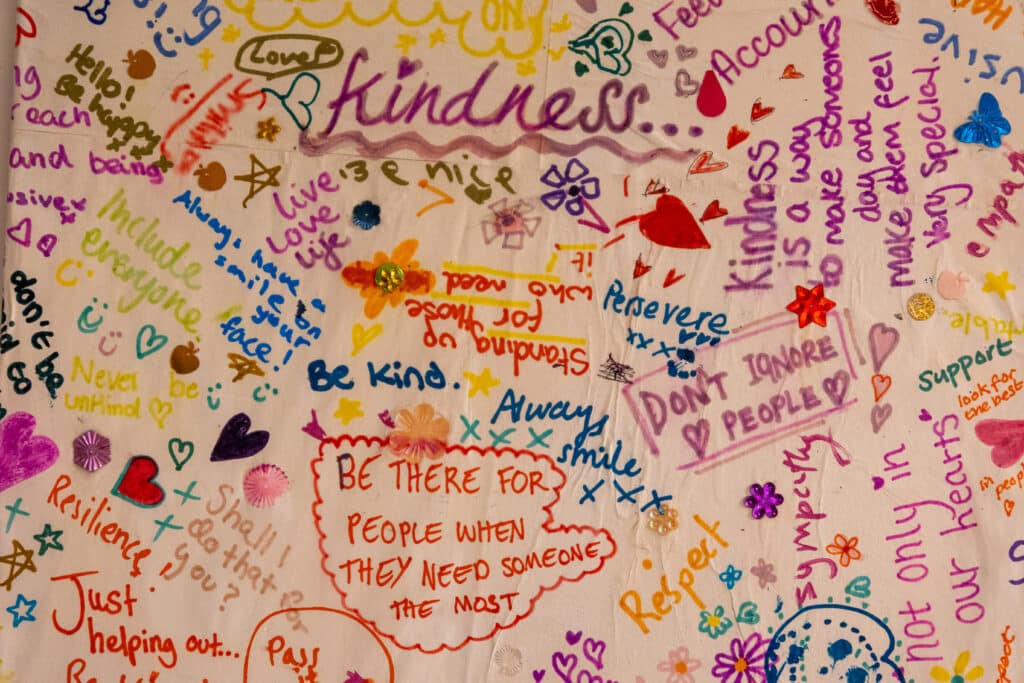
Earlier in the school year, Deputy Head (Academic) Jamie Emmett, spoke to the College about kindness, using the evocative image of the caffè sospeso, a Neapolitan tradition where a customer pays for a coffee for a stranger, to illustrate how small, unseen acts of generosity can have a profound and lasting impact. Drawing on both everyday school life and psychological insight, he reframes kindness not as something soft or secondary, but as a mark of real strength: the choice to encourage rather than criticise, to include rather than exclude, and to respond with patience rather than impulse. In a busy boarding environment, these “suspended coffee” moments ripple through the community, shaping its culture and the individuals within it. His challenge is simple but powerful: if each of us commits to one small act of kindness each day, we can transform not only the experience of others, but the spirit of the whole community.
At the Summer Service on Tuesday 22nd April, Head, Jeremy Quartermain, delivered a moving and thought-provoking reflection on the nature of love, inspired by personal memories of singing at weddings in Ipswich during the 1980s. Drawing on the writings of St Paul and C. S. Lewis, the address explored the enduring power of agape, a selfless, unconditional love that binds communities together; acting for another’s good without the expectation of receiving anything in return. Jeremy invited listeners to consider how it might shape their relationships, their ambitions, and their life at the College. Read the full address here.
In his latest blog, the Head reflects on the quiet power of overlooked voices through the lives and works of two writers, John Kennedy Toole and Gerald Basil Edwards, whose novels achieved acclaim only after their deaths. Drawing on A Confederacy of Dunces and The Book of Ebenezer Le Page, he explores how seemingly unremarkable characters, eccentric, isolated, and often at odds with the world, can reveal profound truths about the human condition. With 2026 being the National Year of Reading, the piece is a thoughtful reminder that literary greatness, like human value, is not always immediately recognised, and that insight, empathy and even a kind of heroism can be found in the most ordinary of lives. Read the full article here.
In Chapel this week, College prefect Josh (D) delivered a thoughtful and engaging reflection on forgiveness, beginning with a personal story about breaking a family table and expecting anger, but instead receiving immediate forgiveness. This moment served as a powerful introduction to the Christian concept of grace, receiving compassion when it is least deserved.
Drawing on the parable of the prodigal son, the assembly explored the depth of God’s love: a love that does not wait for perfection, but actively seeks, welcomes and restores. The message challenged pupils and staff to reflect on the difference between fairness and grace, and to consider a central question – not whether forgiveness is available, but whether we are willing to accept it. You can read the full assembly here.
Working with Nature: How Outdoor Activities Transform Health at Bradfield
by Rich Penny
13th March 2026
In this week’s thoughtpiece, Deputy Head (Pastoral) Richard Penny reflects on the powerful role that outdoor activity and the natural environment play in supporting the health, resilience and personal growth of Bradfield pupils. Drawing on both research and daily life in the Pang Valley, he explains how activities such as cross-country running, CCF, Duke of Edinburgh expeditions, walking, golf and bushcraft help young people build physical strength, emotional balance and confidence.
From the challenge of the Steeplechase to quiet moments walking between lessons, Richard argues that time spent outdoors offers more than exercise – it fosters teamwork, curiosity and the satisfaction that comes from overcoming challenges. Set within Bradfield’s beautiful chalk stream landscape, these experiences help pupils reconnect with nature and discover the restorative benefits of the natural world.
Read Richard’s full blog here to discover why outdoor adventure is such an important part of the Bradfield experience.
On Monday evening, a candlelit vigil was held in the Chapel. Those present prayed for peace and reflected on the suffering of those caught up in the war. Our children are very good at supporting one another, and I know that many reassuring conversations have taken place in boarding houses. In assemblies, we have talked about the importance of being critically reflective when looking at online content. Children can feel overwhelmed by the graphic nature of images and reports which flood across the internet with an immediacy which provides little opportunity to process and/or contextualize.
With World Book Day this week and 2026 being the National Year of Reading, Bradfield is shining a spotlight on the importance of reading for pleasure and encouraging pupils to find something they genuinely enjoy reading and make it part of everyday life.
In this thought-piece, Dr Rachel Maclennan, Director of Teaching and Learning, explores why reading for enjoyment still matters so much for young people – from boosting academic success and reducing stress to broadening horizons and helping pupils develop empathy and curiosity about the world around them. The article also reflects on how easy it is for reading to fall away during the busy teenage years, and how rediscovering books, magazines or audiobooks connected to our own interests can bring the enjoyment back.
In his latest blog, Utopian and Dystopian Visions of the Future, Jeremy reflects on two strikingly different visions of the world our children may inherit. Drawing on ‘Wilding’ by Isabella Tree which describes how a Isabella and her husband returned nature to their family estate in Sussex, Jeremy explores the profound importance of young people forming a deep, lived connection with the natural world. In contrast, he considers the darker digital landscape outlined in Laura Bates’s recent work on online misogyny and artificial intelligence, highlighting the urgent need for protection and education in an increasingly virtual age. Ultimately, he asks what it means to prepare children for the future: to nurture authenticity over avatars, meaningful relationships over transactional encounters, and harmony with nature alongside confident, critical engagement with technology.
Attention, Anxiety and Being Yourself in a Noisy World
by Sarah Davies
13th February 2026
“The things that quietly restore you – music, walking, training, reading, cooking, sitting with a friend, moments without an audience – these are not distractions from real life. They are often clues to who you are beneath the performance. They don’t attract applause. But they do bring you back into alignment.”
Assistant Head (Safeguarding) Sarah Davies spoke in Chapel this week about how small, often overlooked moments of attention: a cup of tea, a piece of music, a quiet pause, can be surprisingly grounding in an increasingly noisy world. Drawing on ideas from writers such as Matt Haig, Stoic philosophy, and the Christian tradition, Sarah considered how constant busyness, comparison and overstimulation can distance us from our sense of self, particularly in high-pressure environments like schools. Rather than rejecting ambition or momentum, Sarah suggested that wellbeing and authenticity come from moments of stillness and attentiveness, which help us realign with what genuinely matters. The key message was simple but powerful: paying attention changes experience and sometimes, starting small is enough.
“Promoting a strong sense of wellbeing is dependent upon adopting an all-encompassing approach. Positive wellbeing is not something that can be ‘taught’ solely in the abstract or as a theoretical subject in the classroom. It is dependent upon the food that we put into our bodies, the exercise that we take, and our ability to live in harmony with the natural world. It is dependent upon our ability to be reflective and creative. It is dependent upon our ability to complement that part of us that is constantly striving with the ability to be still and live authentically in the moment.”
In this blog, Head Jeremy Quartermain reflects on the story of author James Rebanks, who left the pressures of modern life to spend a summer on a remote Norwegian island with a woman preserving the ancient tradition of caring for eider ducks. It is a powerful reminder of how easily we become disconnected from what truly matters when life becomes too busy and too loud.
Jeremy links this story to life at Bradfield, where time in nature, creativity, reflection and community are central to young people’s wellbeing. True flourishing, he suggests, comes from balancing ambition with stillness, and learning to live thoughtfully in the moment, values that sit at the heart of the Bradfield experience.